Your Cart
×
Do these five things while visiting Chester for the first time: the Chester City Walls, the Chester Rows, the Roman Amphitheatre, Grosvenor Park, and the Chester Zoo.

 Select your
Language I Currency
Chester blends Roman ruins, mediaeval walls and unique shopping galleries in a compact, walkable city. This guide covers top sights and practical visitor tips.
 By Admin

Chester is a small city in the northwest of England with a huge amount of history packed into it. The Romans founded it almost two thousand years ago, and it later grew into a walled trading city that never lost its shape. Today you can walk a full circle of ancient walls. You can shop inside two-level galleries found nowhere else in the world. You can stand in the largest Roman arena ever dug up in Britain, then be back at the river in time for an evening stroll.
That compact layout is why first-time visitors love it. Almost everything worth seeing sits a short walk from the Cross, the crossroads at the heart of the old city. This guide keeps it simple, and it covers what to see first, in what order to see it, and how much time you really need.

Here is the short list to build your trip around.
Walk the Chester City Walls, the most complete city walls in Britain
Explore the Chester Rows, the two-level shopping galleries unique to the city
See Chester's Roman side at the Roman Amphitheatre and the Roman Gardens
Visit Chester Cathedral for its cloisters, carved woodwork and tower views
Find the Eastgate Clock and the old streets around Chester Cross
Slow down at Grosvenor Park and the River Dee at the Groves
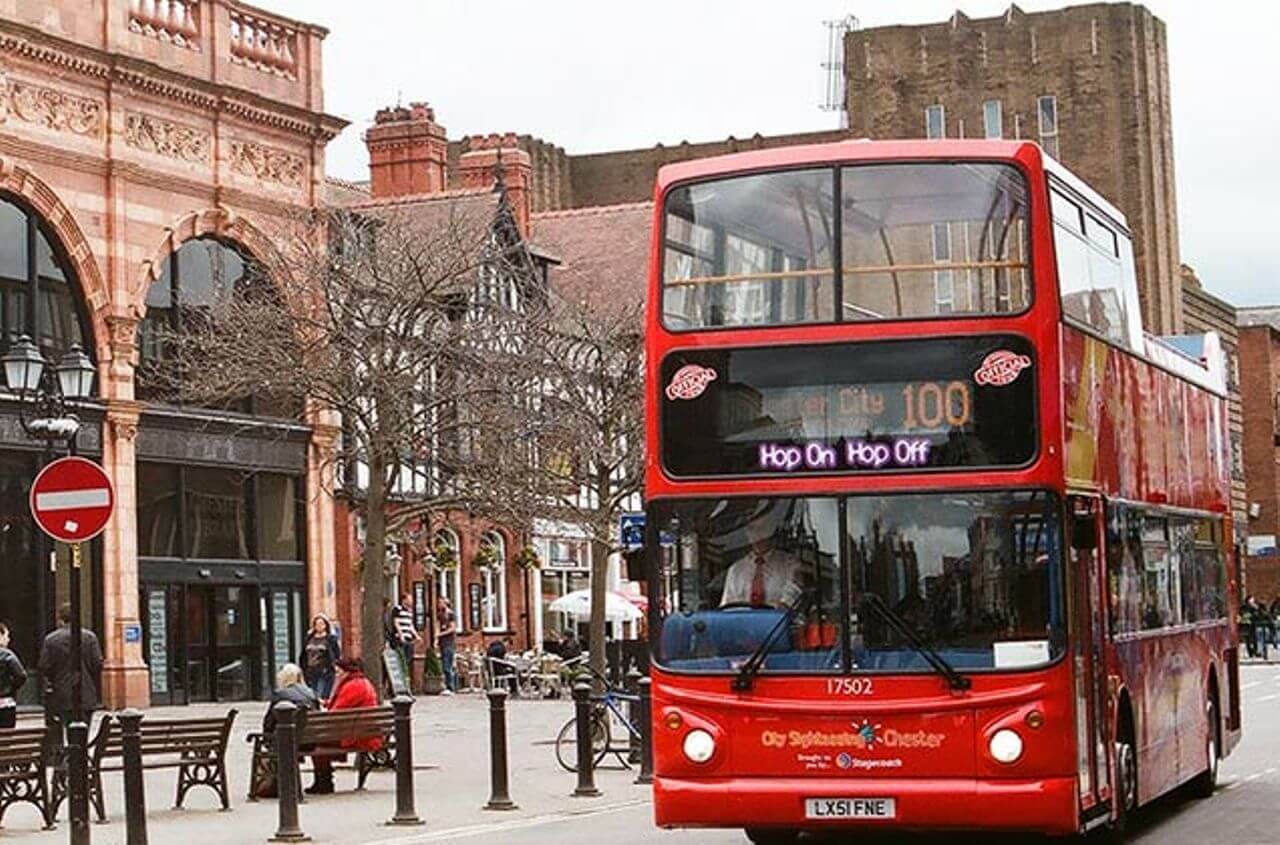
Cover more ground on the Chester Hop-On Hop-Off Bus, including sights beyond the walls
Tick these off, and you have seen the Roman city, the old walled city, and the riverside city in one trip.
Start your journey from the Chester city walls. These walls give you a view of the whole city before you set foot in it. The circuit runs about two miles and includes Roman foundations and Mediaeval repairs, making your way around the walls. The route is free to walk, and you can complete the full circuit in around an hour at a comfortable pace.
The views are worth the effort. Along the way, look across the Roodee racecourse, see Chester Cathedral from above, pass beneath the Eastgate Clock, and enjoy views towards the River Dee.
Don't miss King Charles' Tower, which is traditionally associated with Charles I watching the Battle of Rowton Moor from Chester in 1645, and the Water Tower, built in the 1320s as part of the city's mediaeval defences.
The walls, stone, and steps are uneven sections, so comfortable footwear is recommended. The walls include several steps and uneven sections, so comfortable footwear is recommended.

The Chester Rows are one of the city's defining features, a system of double-decker, two-tiered covered shopping galleries that date back to the Middle Ages.
The rows run along part of Eastgate Street, Watergate Street, Bridge Street, and Northgate Street. Their unusual design creates two levels of shops and walkways, with the upper galleries reached by steps from street level.
Parts of the rows date back to the 1200s and 1300s, and Victorian builders later copied the same black-and-white style. That is why the streets look so neat and unified today.
Give yourself time to walk both levels, not just one. The upper galleries hold small shops, cafes, and local firms. The street level mixes big high street names with much older fronts. Look up as you go, because the best carvings and dates sit above eye level.
Bridge Street and Watergate Street have the oldest stretches and the most charm.
Chester began as Deva, a Roman army fortress built around AD 79 and home to the Twentieth Legion. The street plan you walk today still follows the Roman grid.
The Chester Roman Amphitheatre sits just outside the walls near St. John's Church. It is the largest one ever found in Britain, and only part of it has been dug out. Even so, the open arena, the seating banks, and the entry passages show the scale. Signs explain how the Romans used it for army drill as well as public shows. It is free and open air.
The Roman Gardens are a few steps away, and they display columns, carved tops, and parts of an under-floor heating system found in digs across the city. They run along a green path from the Newgate down to the river.
Both sit at the southeast corner of the walls, so they fit neatly into a walk along the walls. Want more Roman history? The Grosvenor Museum has a fine set of Roman tombstones and carved stones, and it is free to enter.

Chester Cathedral is the city's other remarkable sight, and it rewards a slow visit.
It began as an abbey named for St. Werburgh and became a cathedral in 1541. That is why it still has the monks' buildings that most English cathedrals have lost. The cloisters, chapter house, and dining hall all survive, and they are among the most complete in the country.
Inside, the 14th-century choir stalls are the highlight. Look for the fine carved canopies and the small carvings tucked under the seats.
The stone is red sandstone, which gives the building a warm colour, quite unlike the pale stone cathedrals elsewhere in England. Guided tower tours take small groups up to roof level, where you can see the rooftops and the Welsh hills.
Check opening times, entry rules, and tower tour dates before you go. These change with the season, and tower tours fill up.
The Eastgate Clock is Chester's postcard shot, and you will walk past it without trying.
It sits above the Eastgate on an iron frame, and it went up in 1899 for Queen Victoria's Diamond Jubilee. Many call it one of the most photographed clocks in England. You can see it from the street below, and you can walk right past it on the city walls, which offer a better angle for photos.
From there, the four main streets meet at Chester Cross. The old High Cross stands here, and the town crier appears in the warmer months. The lanes around it are full of black and white fronts, narrow passages, and small squares.
This is the easiest part of the city to explore with no plan at all. Just wander and let the streets take you.
After a morning of walls and Roman stones, the riverside is where Chester slows down.
Grosvenor Park, laid out in the 1860s, is one of the finest Victorian parks in the country. You get tree-lined paths, formal flower beds, a mini railway, and an open-air theater with a summer season. It sits between the arena and the river, so it falls right on your route.
Below the park is the Groves, a wide riverside walkway along the River Dee. There is a bandstand, plenty of benches, ice cream stalls, and a white bridge over to Queen's Park. You can hire a rowing boat, take a short cruise upriver, or simply walk to the Old Dee Bridge and back.
Boat hire and river cruises run by season and by weather, so check on the day rather than planning around them.

Chester's old core is easy to walk, but some of its best-known sights are not. Chester Zoo is located a few miles north of the city, while Blue Planet Aquarium is even further out. This area is where an open-top bus earns its place.
The Chester Hop-On Hop-Off Bus runs a loop around the main sights. Stops include the Grosvenor Museum, Castle Drive, Lower Bridge Street, St. John's Church, Vicars Lane, the Groves, Grosvenor Street, and Chester Zoo. Tickets come as 24, 48, or 72-hour passes. You can ride the full loop once for the audio guide, then use the bus for the rest of your stay.
Two things make it especially useful for first-time visitors. The audio guide adds context you would miss on your own, tying the Roman fortress, the walls, and the Rows into one story. It also saves your legs, which count on a trip with this much walking on cobbles and stone steps.
Check the route, the stop list, and the running times before you travel, as they change by season.
Explore the World with Hop On Hop Off Bus Tours – Find Your Destination and Start Your Adventure Today!
Hop On Hop Off London
Hop On Hop Off Inverness
Hop On Hop Off York
Hop On Hop Off Belfast
Hop On Hop Off Stratford-upon-Avon
You can see many of Chester's major attractions in one well-planned day, but staying for two or three days gives you time to explore without rushing. Walk the walls first, come down at the Eastgate, and then take in the Rows, Chester Cathedral, and the Eastgate Clock. From there it is a short walk to the Roman Amphitheatre and the Roman Gardens, which puts you at Grosvenor Park and the Groves by late afternoon.
A second day is for the slower things: the Grosvenor Museum, Chester Castle, and the Agricola Tower, and an hour on the water. Chester Zoo needs a day of its own, so save that for a third. Whatever you cut, keep the walls, the rows, the Roman sights, and the cathedral.
For most first-time visitors, the best approach is to see the walls, rows, Roman sights, and cathedral first, then use your remaining time for the attractions and experiences that interest you most.
Chester has a small geography; still, first-time visitors on short trips should know a few things to make their journey memorable rather than exhausting.
Keep shoes with grip, as the walls are worn stone with steps at every gate, and plenty of the old streets are cobbled.
At least spend one hour around the walls and plan for longer if you stop for photos
Timetables and rules shift with the season, so check the updated timetable and rules for the cathedral, the museum, and the bus route. Check the day before, not in the morning.
Always choose the attraction location-wise. Walls and Eastgate are in the centre, the amphitheatre and Roman Gardens are to the southeast, and the park and river are to the south.
Carry a jacket even on a clear morning.
Go earlier or after 4 if you want the empty rows in the galleries for yourself.
One loop on the sightseeing bus makes the rest of the day easier to plan.
What stays with people about Chester is not just one single building. It’s a Roman wall, a mediaeval shopping street, and the river. Walk the walls, take your time in the rows, and keep an hour back for the Dee.
Chester packs an unusual amount of history into a space you can cross on foot in twenty minutes. Few English cities let you walk a Roman fortress, a complete mediaeval wall, and a two-tier shopping gallery all in the same afternoon, then unwind by a river as the day winds down.
If you only remember three things, make them these: walk the full circuit of the walls to get your bearings, spend real time in the Rows rather than rushing through, and save an hour for the Groves when your legs need a break. Everything else in this guide fits around those three.
Whether you have a single day or a long weekend, Chester rewards visitors who slow down and look up at the carvings above the shopfronts, the view from King Charles' Tower, or the Welsh hills from the cathedral roof. Plan around the walls, the rows, the Roman sights, and the cathedral, and the rest of your trip will fall into place.
Do these five things while visiting Chester for the first time: the Chester City Walls, the Chester Rows, the Roman Amphitheatre, Grosvenor Park, and the Chester Zoo.
Yes. You can cross the old centre in about twenty minutes, keeping the walls, the rows, the cathedral, the Roman sights, and the river to make your day memorable.
If you're a first-time visitor, start your journey from the walls. From up there, you can see how the cathedral, amphitheatre, racecourse, and river relate to each other.
Yes. Twenty minutes gets you across the old centre, and the walls, the Rows, the cathedral, the Eastgate Clock, and the Roman sites all sit inside it. Chester Zoo and Blue Planet Aquarium are the exceptions, and both need transport.
Chester's main historic attractions include the city walls, the Chester Rows, the Roman Amphitheatre and Roman Gardens, Chester Cathedral, the Eastgate Clock, Chester Castle with the Agricola Tower, and St John the Baptist's Church.
Yes, the hop-on hop-off bus is worth it for two reasons: getting out to Chester Zoo and resting your legs after a morning on cobbles. With a ticket you get a full loop ride along with commentary.